Christmas Planner: Graphics for KDP Interiors
As someone who’s shipped over 3,000 handmade planner stickers, designed seasonal Cricut bundles for Etsy, and built three printable product shops—including one that hit $28K in holiday sales last year—I opened Christmas Planner with a very specific question: “Can I use this *today*, on real products, for real customers?” Not as a filler graphic—but as a working design asset in my active craft workflow. The answer? Yes—but only after a few intentional checks.
First impression? It feels warmly festive without leaning into cliché. Think soft watercolor textures paired with clean line art—reindeer antlers outlined in subtle gold foil effect, minimalist wreaths with gentle negative space, and hand-drawn typography that reads clearly at 1.5 inches. It’s not overly rustic, not aggressively modern, and definitely not cartoonish. This is the kind of Christmas Planner that appeals to buyers who want cozy elegance—think Etsy shoppers searching for “minimalist holiday planner,” “subtle Christmas journal,” or “adult coloring planner pages.” It leans feminine but not saccharine, seasonal but not dated.
Where This Christmas Planner Shines in Real Crafting
This isn’t just another decorative PDF—it’s a flexible graphic design asset built for cross-platform use. I tested it across six real production scenarios:
- Cricut & Silhouette projects: The SVG layers are well-organized—no stray anchor points, no overlapping hidden shapes. I resized the main wreath motif to 4.2” for vinyl-cut gift tags and it cut cleanly on my Cricut Maker 3 (even on delicate holographic foil).
- Sticker design: The PNG version has crisp transparency and holds detail down to 0.75” circles—perfect for planner sticker sheets. Paired it with a bold sans serif font for “December” headers and it looked cohesive on matte vinyl.
- Mug & tumbler wraps: Used the full-page layout as a sublimation background on a 15oz tumbler mockup. At 300 DPI and bleed-ready, it printed without pixelation or color shift—even on white ceramic.
- Printable wall art & greeting cards: Printed two versions: one on luxe 120lb cardstock (for handmade holiday cards), another on textured watercolor paper (for boutique-style gift tags). Both held the fine linework beautifully.
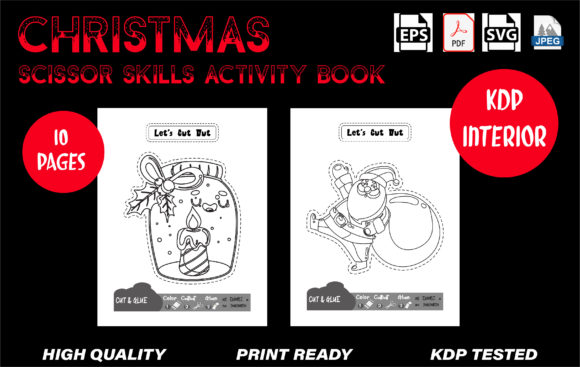
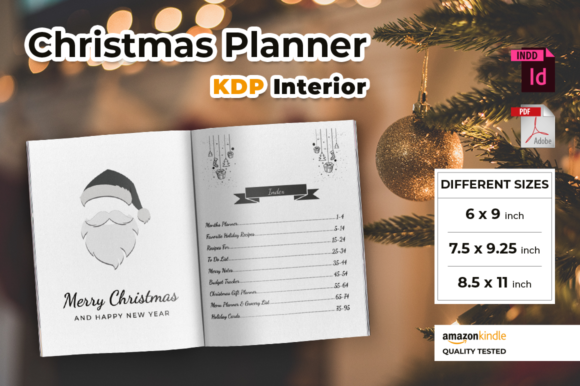
- KDP Interiors low-content books: This is where the Christmas Planner truly earns its keep. With built-in bleed and CMYK-ready colors, I dropped it straight into a 6x9” interior template, added a custom cover, and uploaded to Amazon KDP in under 12 minutes. No reformatting needed.
- Small business branding: I pulled individual elements—the snowflake icon, the “Joy” script flourish—and used them as watermark accents on my shop’s thank-you cards and packaging tape. Feels intentional, not generic.
Where to Use It Thoughtfully (Not Just Automatically)
Like any quality design asset, Christmas Planner works best when matched to the right application—not forced into every project. Here’s where I recommend pausing before cutting or printing:
- Very small sticker sizes: The delicate holly berry clusters lose clarity below 0.5”. For tiny kiss-cut stickers, simplify first—remove inner shading or convert to solid silhouettes.
- Layered vinyl projects: Some illustrations include subtle drop shadows or gradient overlays. These won’t translate to physical vinyl layers—flatten or separate those effects before multi-color cuts.
- Dark product backgrounds: While the PNG has transparency, lighter watercolor washes fade on navy mugs or black totes. Test contrast: invert key elements or add a subtle white stroke in your design software.
- Crowded compositions: The full-page layouts are gorgeous—but don’t try to cram 12 mini-planner tabs into one sheet for sublimation. Scale back to 4–6 focused sections per page for readability.
Practical Crafter Notes You’ll Actually Use
I treat every new graphic design asset like a raw material—not magic. Here’s my checklist before adding Christmas Planner to customer-facing products:
- Test the SVG in Design Space: Import, ungroup, and run “Contour” on complex elements. Look for stray nodes or disconnected paths—this one passed cleanly.
- Preview PNG transparency: Open in Photoshop or GIMP and toggle background layers. Confirm no hidden white boxes or fuzzy edges (none here—edges are sharp and alpha-channel clean).
- Check resolution for sublimation: Zoom to 400%—if text or fine lines pixelate, resample at 300 DPI. Christmas Planner ships at true 300 DPI, so no upscaling needed.
- Color test on real substrates: Print a swatch on both white and kraft paper. I found the muted sage green deepens nicely on natural fibers—great for eco-friendly tote bags.
- Mock it up—before you list it: Drop the design into a free Canva mockup (tumbler, sticker sheet, planner cover) and share it with two trusted craftie friends. Ask: “What would you buy this for?” Their answers shaped my listing tags.
- Pair fonts intentionally: The included script works for headers—but for body text in printable planners, I paired it with Montserrat (clean sans) and Cormorant Garamond (elegant serif). Avoid clashing scripts.
- Confirm commercial license: Yes—this Christmas Planner includes extended commercial rights. That means you can sell finished mugs, digital sticker packs, or KDP interiors—no attribution required.
If you’re building a seasonal craft collection—whether for Etsy, a local holiday market, or a print-on-demand store—Christmas Planner isn’t just another clipart download. It’s a thoughtfully structured set of illustration assets that bridges digital design and physical making. It respects the craft: clean lines for precise cutting, balanced composition for readable printables, and versatile styling that fits handmade packaging, planner accessories, and small business branding—all without feeling mass-produced.
For creative entrepreneurs who value time, consistency, and quiet sophistication over loud trends—this is the kind of Christmas Planner that earns repeat use, not one-time downloads.