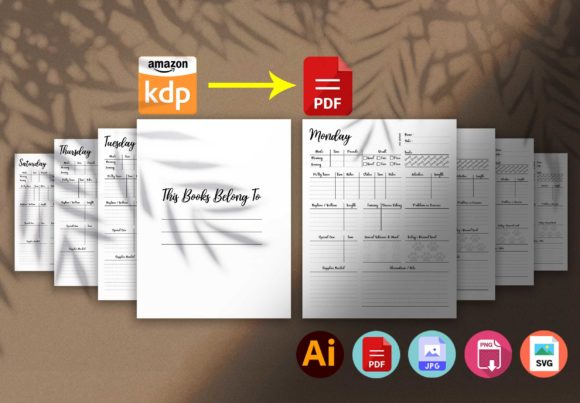
7 Day Pet Report Card
A Designer’s First Glance: Playful, Clean, and Purpose-Built
When I opened 7 Day Pet Report Card for the first time, my eye went straight to its balance—light enough to feel cheerful, structured enough to hold up in stitching. It’s not a cartoon explosion or an overly cutesy illustration; it’s a gentle, organized visual that reads like a real (but adorable) report card. The layout suggests rows, checkboxes, and small icons—ideal for embroidery where clarity matters more than flourish. As a designer who regularly translates digital graphics into stitched reality, I immediately pictured this on a linen tea towel for a pet-loving boutique owner, or as a custom patch sewn onto a canvas tote for a local animal shelter fundraiser.
Where It Shines: Real Projects, Real Customers
I tested 7 Day Pet Report Card as part of a small-batch embroidered kitchen towel line—meant for Etsy sellers and craft fair vendors who want lighthearted, giftable home goods. On medium-weight cotton twill, with a light tear-away stabilizer, the design held crisp lines without excessive density. The lettering stayed legible at 3.5" wide, and the subtle grid structure translated well into satin-stitched borders and clean running-stitch checkmarks. It worked especially well for personalized gifts: adding a pet’s name above the header turned a generic graphic into a heartfelt, one-of-a-kind item.
For sweatshirt embroidery? Yes—but with caveats. On a midweight fleece, I resized it to 4.25" wide and added a cutaway stabilizer underneath. The open spacing between rows prevented puckering, and the minimal fill areas kept stitch time reasonable. It also translated cleanly to baby onesies when scaled down to 2.75", though I avoided the tiniest checkbox details—those got lost in the fabric weave and required simplification in my digitizing software before stitching.
Where to Pause—and Why
7 Day Pet Report Card isn’t built for ultra-fine detail work. If you’re planning to embroider it inside a 3" hoop on stretchy jersey or thin rayon, reconsider. The narrow columns and delicate line weights won’t survive low thread tension or shifting fabric without careful stabilization and possibly manual editing. Likewise, on dark fabric, the original PDF’s light-on-dark contrast doesn’t guarantee readability once stitched—you’ll need to adjust thread colors thoughtfully (think cream on navy, not pale yellow). And if you’re applying it to curved surfaces—like the front panel of a dad cap—the top row of text may distort unless you use a cap frame or reduce width by 10%.
Also worth noting: because 7 Day Pet Report Card is labeled “Best For KDP Print” and delivered as a Print Ready PDF, it’s optimized for flat reproduction—not machine embroidery files. That means it’s not a ready-to-load embroidery file (no .dst, .pes, or .jef), nor does it include appliqué layers or stitch maps. You’ll need to digitize it yourself—or hire a digitizer—if your end goal is actual embroidery. Don’t assume it’s plug-and-play for your Brother or Bernina.
Design Integrity Meets Commercial Sense
What makes 7 Day Pet Report Card stand out in a sea of pet-themed graphics is its quiet professionalism. It doesn’t shout—it invites. That tone carries through to finished products: customers respond to its warmth and specificity, not just its cuteness. When used on nursery decor or holiday gift tags, it feels intentional, not mass-produced. That builds trust—especially for Etsy sellers positioning themselves as thoughtful, detail-oriented makers.
It also supports brand consistency beautifully. Pair it with a simple sans-serif monogram or a coordinating paw-print border, and you’ve got a cohesive collection—whether you’re designing embroidered pillow covers for a small shop or building printable mockups for your digital product listings. Just remember: because it’s categorized under Kdp Interiors and listed as Graphics, it’s likely intended as a design asset for printed interiors (wall art, planners, cards)—not as a licensed embroidery file. Always confirm usage rights before selling stitched items or bundling it into commercial embroidery packs.
Practical Notes Every Embroiderer Should Run Through
- Test first: Stitch a sample on scrap fabric matching your final project’s weight and texture—even if it’s just one row.
- Check contrast: View your thread color choices against both light and dark fabric backgrounds in natural light.
- Review stitch density: High-fill areas (like headers or icons) may need reduced density to avoid stiffness on soft fabrics.
- Confirm hoop size: Measure the widest element—including margins—to avoid awkward trimming or rehooping mid-project.
- Inspect small details: Tiny checkboxes or fine dividers often vanish on textured or loosely woven cloth—simplify or enlarge them.
- Mock it digitally: Drop the PDF into a black-and-white mockup to gauge readability before digitizing.
- Stabilizer choice matters: Use cutaway for knits, tear-away for stable wovens, and fusible for lightweight linens.
- Licensing check: Since this is marketed for KDP and print use, verify whether commercial embroidery rights are included—or if you need separate permission to sell finished embroidered goods.
Final Thought: A Thoughtful Tool, Not a Magic Button
7 Day Pet Report Card is the kind of design that works hardest when treated with intention. It’s not flashy—but it’s reliable, adaptable, and full of quiet charm. For embroidery designers building custom apparel, for crafters launching a pet-themed line, or for small shop owners sourcing design assets that feel handmade without looking amateurish—it’s a smart starting point. Just remember: great embroidery starts long before the needle drops. It starts with knowing what the design *is*, what it *isn’t*, and how you’ll honor both in your next finished product.